- AI-powered
- Scenario-based
- Custom animation
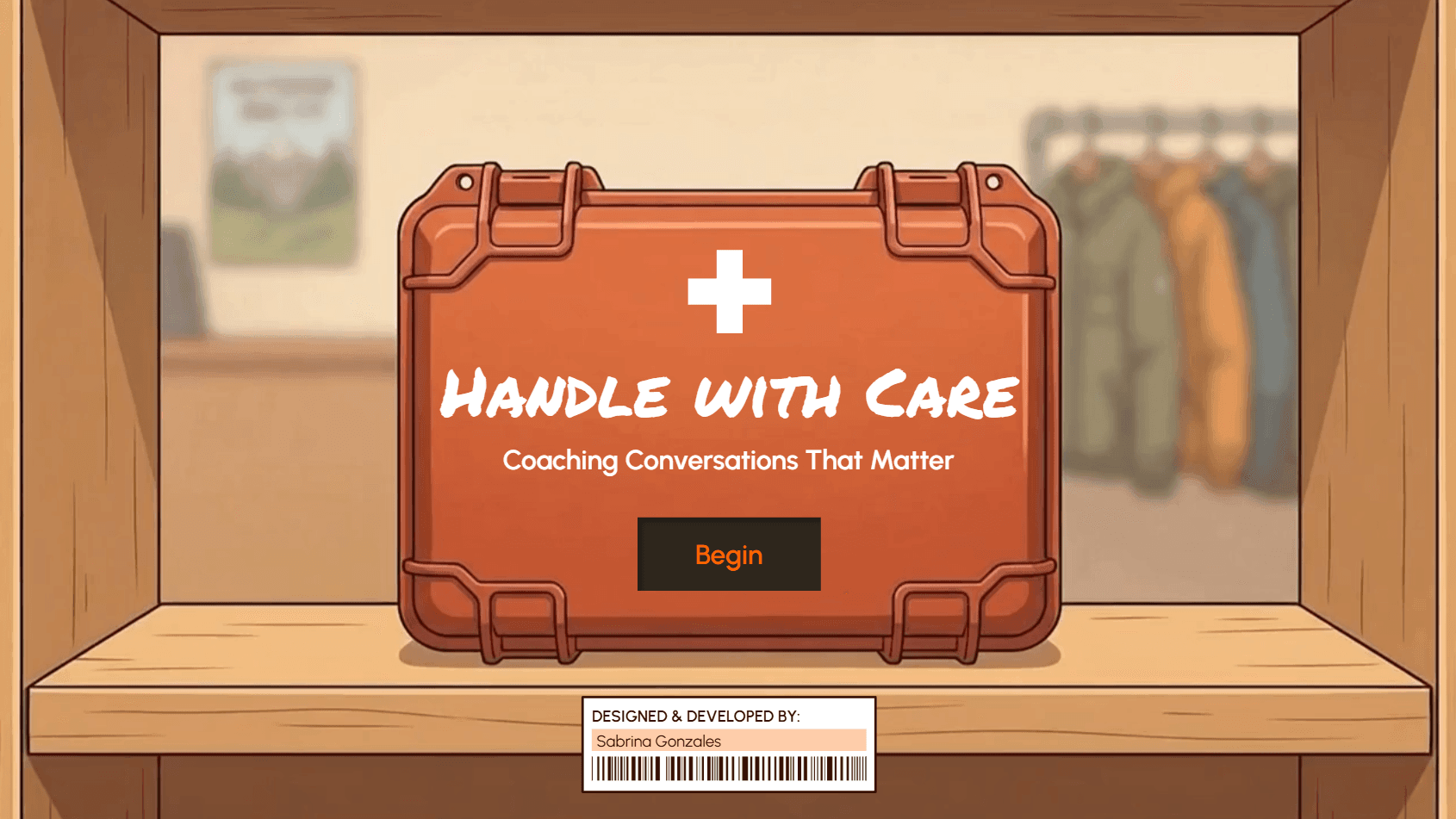
Handle with Care: Coaching Conversations that Matter
 Overview
A safe place to practice hard conversations
In this scenario-based coaching simulation, managers navigate two critical conversations with an under-performing employee. Powered by AI, the employee responds naturally to how the conversation unfolds — and the outcome ranges from breakthrough to resignation.
 The Problem
Coaching without a playbook
Summit Trail Outfitters is a conceptual outdoor retail company specializing in camping, hiking, climbing, and other outdoor gear. As the company grows, many first-time managers are stepping into leadership roles with little experience coaching employees through performance issues.
One challenge managers frequently face is identifying why an employee’s performance has declined before deciding how to address it. Jumping to conclusions or choosing the wrong coaching approach can cause employees to become disengaged, damage trust, and ultimately lead to unnecessary turnover. Managers need to recognize that underperformance is not always caused by a lack of ability — and that different situations require different coaching strategies.
 The Solution
A two-part coaching simulation
I designed a two-part coaching simulation where learners step into the role of a manager addressing an employee’s declining performance. Through two AI-powered one-on-one conversations, learners first identify the root cause of the performance issue and then develop an appropriate coaching plan.
Between meetings, they can reference a coaching job aid before conducting a follow-up conversation that adapts to their decisions. The simulation concludes with a realistic workplace outcome — ranging from improved performance to a performance improvement plan or employee exit — followed by personalized feedback that reinforces effective coaching strategies.
The ProcessFrom opening scene to personalized feedback
Designing for authentic practice
Helping managers coach underperforming employees requires more than recognizing that performance has declined. They need to uncover the root cause, adapt their coaching approach, and work collaboratively with employees to create an effective plan. Rather than presenting a series of multiple-choice conversations, I wanted learners to practice authentic coaching discussions where they could ask their own questions, respond naturally, and experience the consequences of their decisions in a realistic workplace setting.
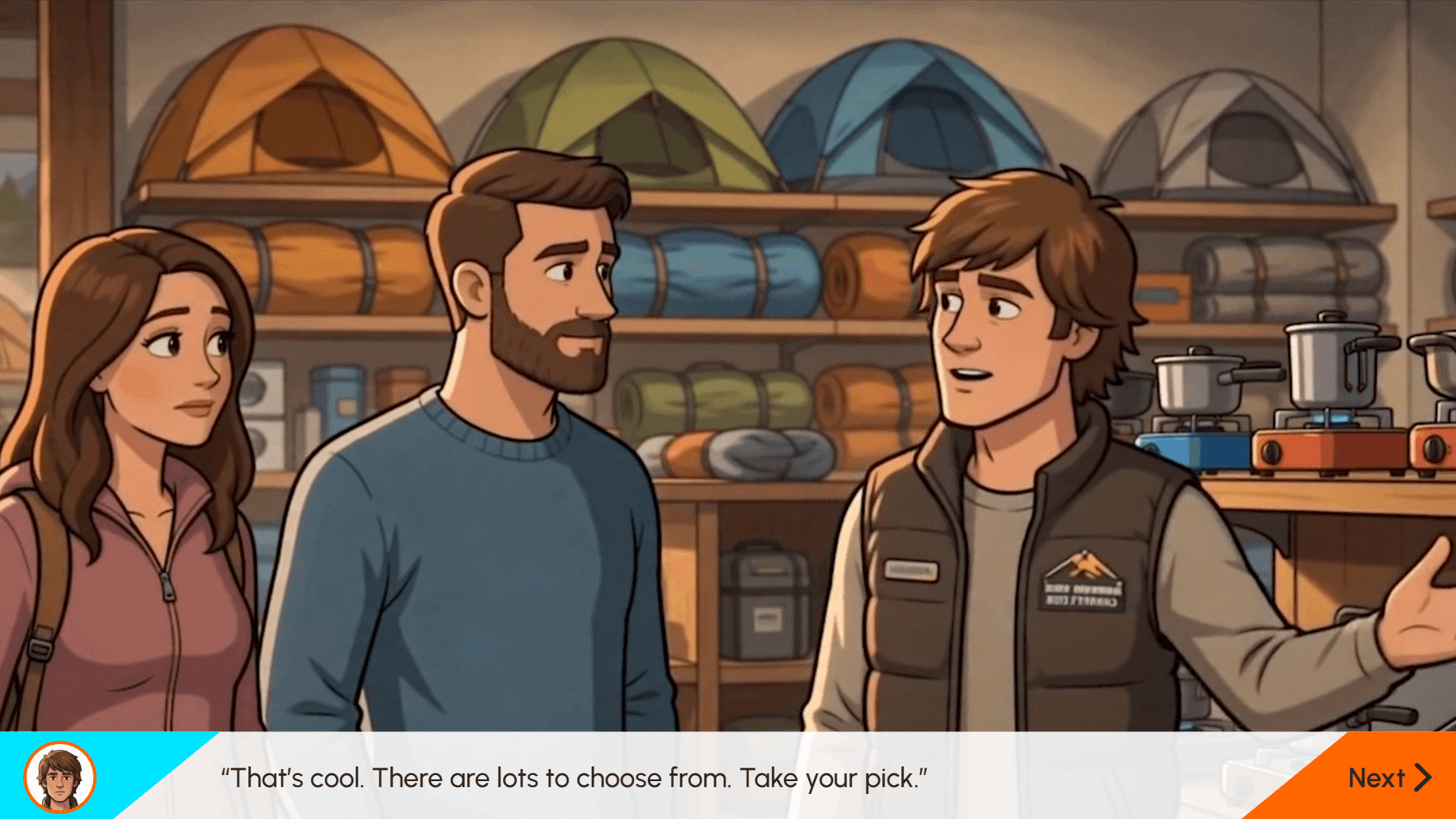
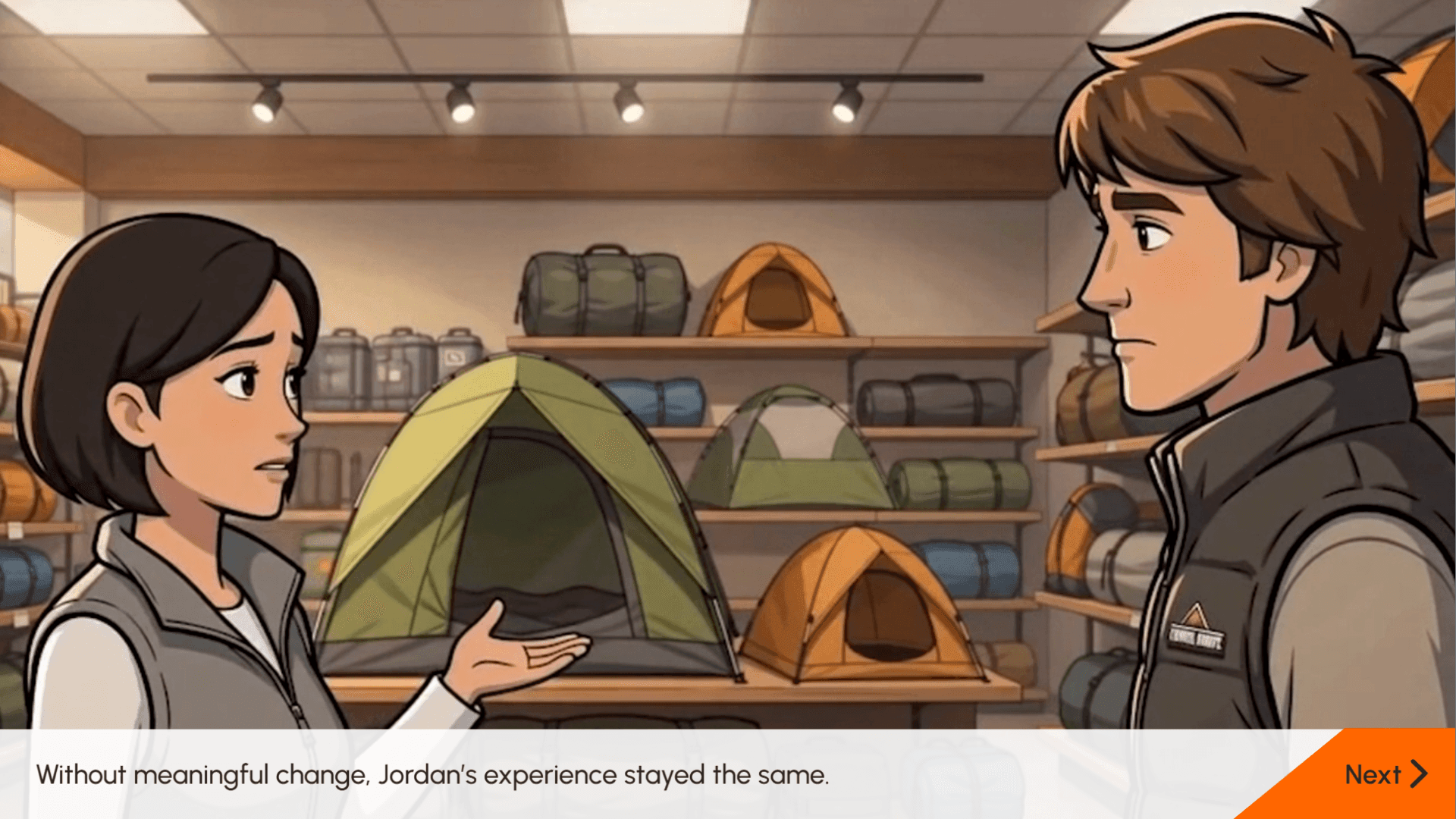
I began by designing an opening sequence that places learners inside Summit Trail Outfitters before the title screen even appears. As they walk through the store, they observe two employees interacting with customers — one demonstrating strong performance and Jordan showing subtle signs of disengagement.
After the introduction, learners receive a manager briefing and review a calendar that summarizes Jordan’s recent performance, outlines their objectives for the first one-on-one, and serves as a reference throughout the conversation.
Building the coaching conversations
To create the coaching conversations, I built two AI-powered employee simulations using devlin.ai and integrated them into Articulate Storyline. During each conversation, Jordan responds naturally to the learner’s questions while his body language changes in real time to reflect his emotional state — becoming more engaged, frustrated, or withdrawn based on how the conversation unfolds. Rather than scripting every possible response, the AI lets learners have authentic conversations while Storyline tracks their progress toward the learning objectives.
Connecting the two conversations
Between meetings, learners return to the calendar to review how they performed during the first conversation and prepare for the follow-up. The calendar doubles as a lightweight job aid, providing coaching strategies tailored to the performance issue the learner identified. During the second conversation, learners work with Jordan to develop a plan that addresses the underlying cause of his disengagement — before seeing the long-term impact of their coaching through one of three workplace outcomes: celebrating Jordan’s renewed performance, scheduling a continued performance check-in, or attending Jordan’s final day with the company.
Personalizing the feedback
I also wanted feedback to feel as personalized as the conversations themselves. Using devlin.ai, I created evaluation criteria tied directly to the performance objectives so learners receive AI-generated feedback after completing both coaching conversations. Instead of simply indicating success or failure, the feedback explains how effectively they diagnosed the performance issue, built rapport with Jordan, and collaborated on an appropriate coaching plan.
ResultsMeasuring what matters
Because this is a conceptual project, the next step would be to pilot the simulation with a small group of frontline managers and gather both learner feedback and AI-generated evaluation data. Observing where managers struggle to identify performance issues or develop coaching plans would help refine the conversations, coaching guidance, and feedback before deploying the experience more broadly.
After implementation, I would evaluate the simulation using both learning and business metrics — analyzing AI-generated feedback to surface common coaching skill gaps in the short term, then comparing organizational performance against the original business goals six months after launch.
Target reduction in voluntary employee turnover as managers consistently diagnose the root cause of underperformance.
Target lift in employee satisfaction related to manager support after the coaching approach takes hold.
Projected success metrics for a conceptual pilot.
TakeawaysWhat I took away
One of the biggest takeaways was how AI can create more authentic practice opportunities without sacrificing instructional design. Every learner can approach the conversations differently, ask different questions, and build rapport in their own way while still working toward the same learning objectives. That flexibility creates a much more realistic coaching experience than traditional branching dialogue or multiple-choice scenarios.
Another valuable lesson came from building the visual experience. Creating consistent animated versions of Jordan across multiple scenes required developing a repeatable AI workflow using Magnific’s generative tools. After refining that process, I shared the workflow in my YouTube video, “I Made These AI Animated Videos in Minutes… You Can Too!” — demonstrating how instructional designers can create cohesive AI-generated visuals without spending days on asset creation.
Finally, this project reinforced my belief that AI works best when it expands learner choice rather than replaces instructional design. Instead of limiting learners to a handful of predetermined responses, the simulation gives managers the freedom to communicate naturally while the experience stays anchored by clear performance objectives and meaningful feedback. That combination of authentic conversation and structured evaluation is what makes AI-powered simulations so exciting for workplace learning.
Ready to coach Jordan yourself?
Step into the manager’s role and coach Jordan through both conversations yourself.